













Introduction
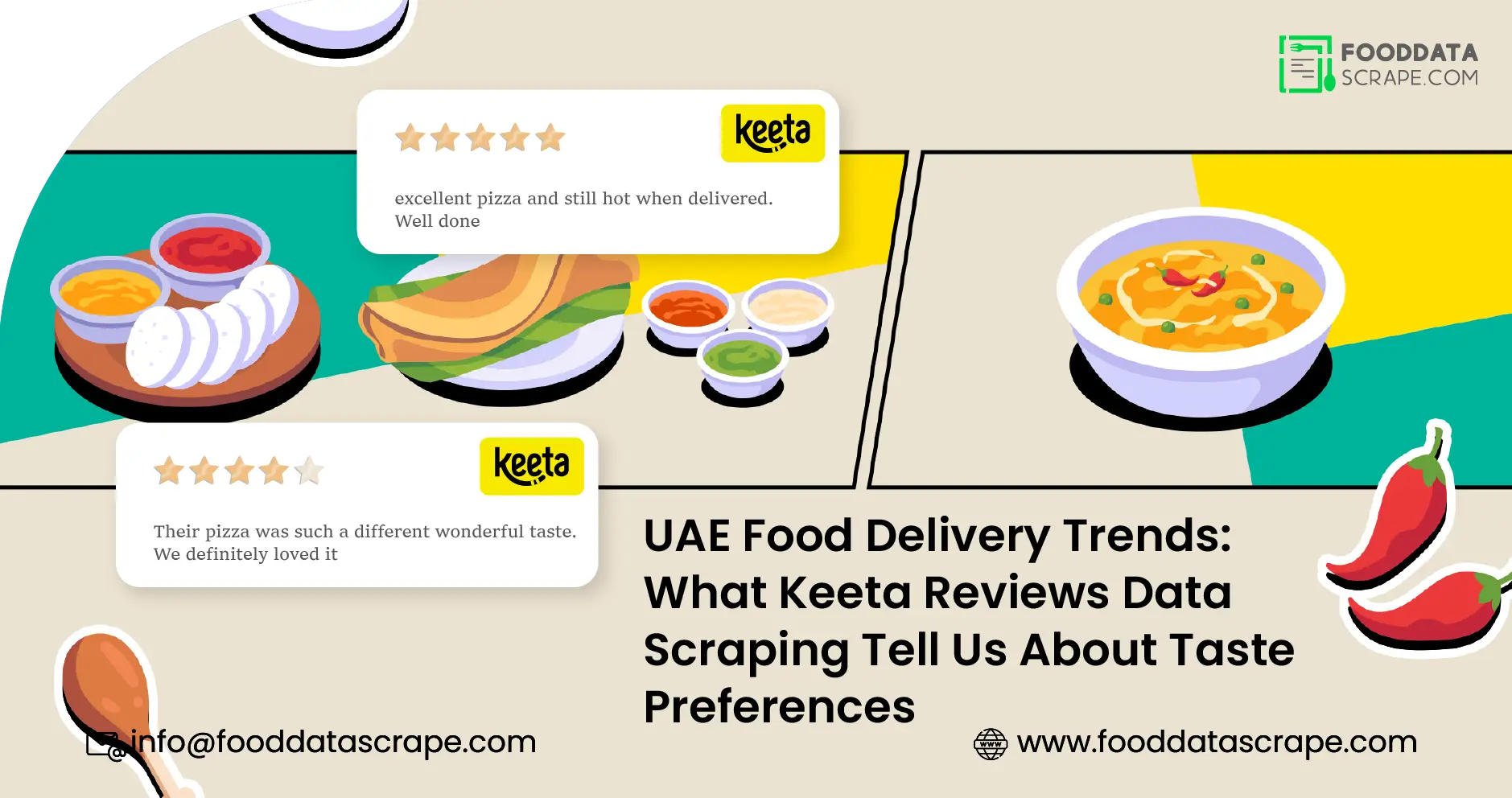
The UAE food delivery market is expanding rapidly, driven by digital adoption, multicultural cuisine demand, and evolving consumer taste preferences. Platforms like Keeta are generating massive volumes of customer feedback, ratings, and menu-level insights that can guide restaurants, aggregators, and food brands toward data-driven growth. By leveraging Keeta Reviews Data Scraping, businesses can unlock actionable insights hidden within customer comments, star ratings, delivery experiences, and repeat ordering patterns.
Understanding UAE Food Delivery Trends requires more than surface-level analysis. It demands deep exploration of cuisine popularity shifts, pricing sensitivity, delivery time expectations, packaging satisfaction, dietary preferences, and regional taste differences across Dubai, Abu Dhabi, Sharjah, and beyond. This is where structured data extraction becomes crucial.
Through Web Scraping Keeta Food Delivery Reviews, companies can systematically collect review text, ratings distribution, timestamps, restaurant metadata, menu mentions, and sentiment indicators. This data enables advanced analytics on what customers truly value — whether it is faster delivery, authentic flavors, healthier options, or premium packaging.
Why Keeta Review Data Matters in the UAE Market?
The UAE food delivery ecosystem is unique due to its multicultural population. Emirati, Indian, Pakistani, Filipino, Lebanese, American, Japanese, and European cuisines coexist in one marketplace. Customer reviews reflect nuanced expectations — spice levels, authenticity, portion sizes, halal compliance, fusion innovation, and presentation standards.
When businesses Scrape Keeta App Reviews Data, they gain visibility into real customer experiences at scale. Instead of relying on small surveys or internal feedback, scraped review datasets provide thousands of real-time opinions. This helps brands answer critical questions:
- Are customers preferring spicy or mild options?
- Is plant-based demand increasing?
- Are late-night orders dominated by fast food or comfort meals?
- Which cuisines are trending during Ramadan or festive seasons?
Deep Insights Through Structured Review Extraction
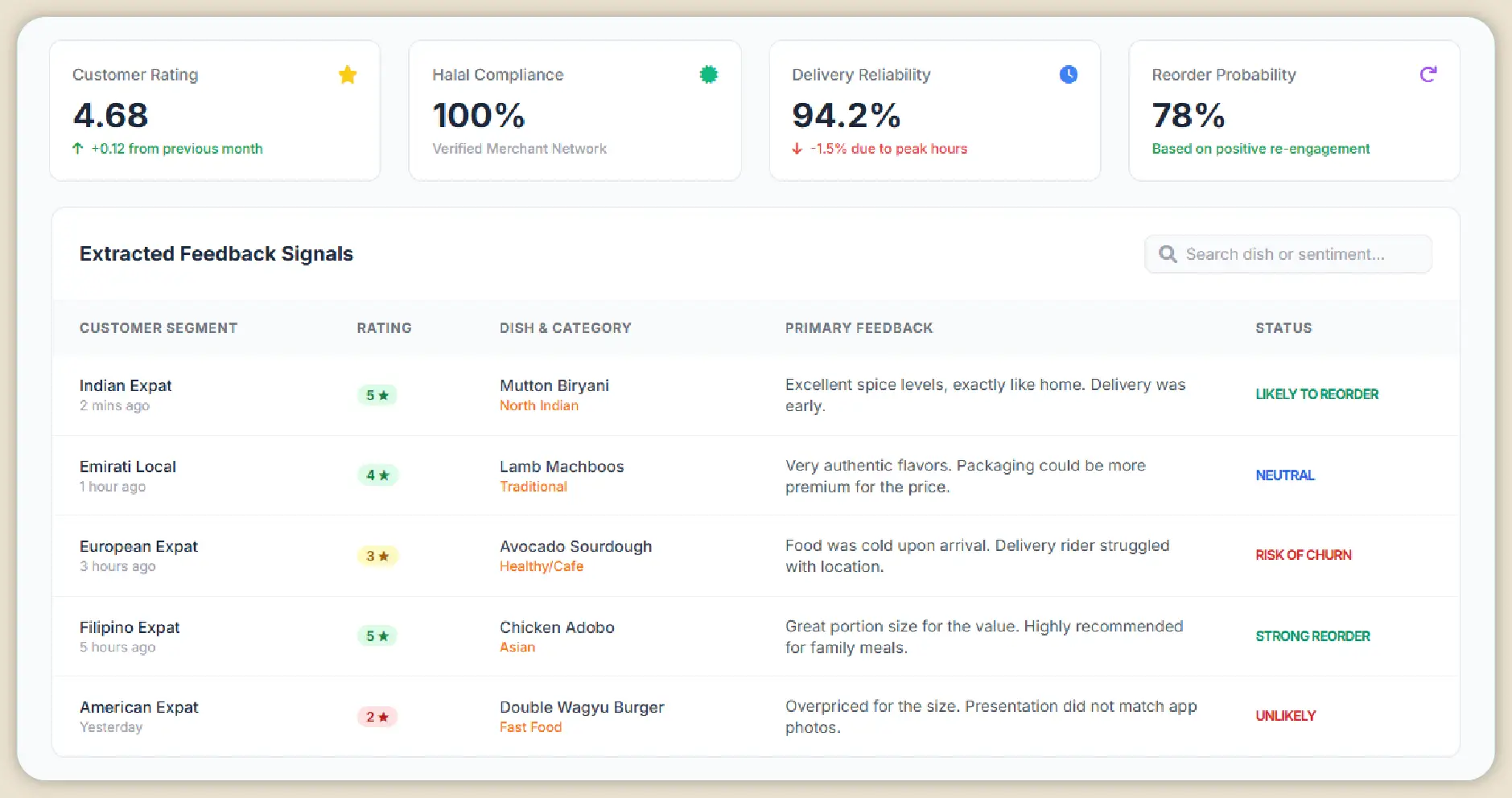
Modern analytics depends on clean, structured datasets. Using UAE Food Delivery Review Data Extraction, raw textual reviews are transformed into organized formats such as CSV, JSON, or database-ready tables. This includes:
- Customer ratings (1–5 stars)
- Review timestamps
- Order categories
- Mentioned dishes
- Delivery performance comments
- Price feedback
- Reorder likelihood signals
These insights reveal patterns such as rising dissatisfaction with delayed deliveries or increasing praise for sustainable packaging. Businesses can respond quickly by adjusting operations or marketing strategies.
Sentiment Analysis and Taste Preference Mapping
One of the most powerful applications of Keeta Ratings and Reviews Scraping is sentiment analysis. By processing review text through natural language processing models, companies can classify opinions into positive, neutral, or negative sentiments.
Beyond basic sentiment, advanced analytics identifies taste drivers such as:
- “Authentic flavor” mentions for Middle Eastern dishes
- “Creamy texture” appreciation in dessert categories
- “Too oily” complaints in fried items
- “Perfect spice level” endorsements in South Asian cuisine
These patterns help brands refine recipes, standardize preparation, and align menus with local preferences.
Understanding Restaurant-Level Performance
Restaurants competing on Keeta must continuously optimize their digital presence. When businesses Extract Keeta Customer Reviews for UAE Restaurants, they can benchmark performance across competitors.
For example:
- Compare average ratings across pizza brands in Dubai Marina
- Track feedback trends for burger chains in Abu Dhabi
- Identify top-performing sushi outlets based on review frequency
- Analyze complaint themes related to delivery packaging
Such benchmarking enables restaurants to improve operational efficiency, reduce churn, and enhance brand perception.
Building a Comprehensive Keeta Food Dataset
A well-structured Keeta Food Delivery Dataset from UAE goes beyond reviews. It can include restaurant listings, cuisine categories, menu pricing, discount campaigns, delivery fees, estimated time slots, and geographic distribution.
With this dataset, analysts can examine:
- Which areas show high order density
- What price ranges dominate different neighborhoods
- Which cuisines see higher weekend spikes
- How promotional discounts affect ratings
This comprehensive approach provides both macro-level market trends and micro-level performance metrics.
Leveraging Automation for Scalable Insights
Manual data collection is inefficient and incomplete. By deploying a Keeta Food Delivery Scraping API, businesses can automate data extraction processes at scale. APIs ensure consistent updates, enabling near real-time monitoring of review patterns, rating shifts, and menu updates.
Automation helps:
- Track trending dishes weekly
- Monitor competitor pricing changes
- Detect sudden drops in ratings
- Identify viral food trends
This empowers brands to make proactive decisions instead of reactive adjustments.
Professional Data Scraping Services for Accuracy
Many companies rely on specialized Keeta Food Delivery App Data Scraping Services to ensure compliant, accurate, and scalable data extraction. Professional scraping frameworks include anti-block mechanisms, structured data parsing, error handling, and regular updates.
Such services ensure high-quality datasets suitable for machine learning models, predictive analytics, and BI dashboards.
Identifying Broader UAE Food Delivery Trends
When applying Web Scraping Food Delivery Data techniques across categories, businesses can uncover cross-platform insights. Trends emerging in Keeta reviews may signal broader consumer behavior patterns such as:
- Growing demand for healthy bowls and low-carb options
- Increased preference for contactless delivery
- Popularity of premium dessert add-ons
- Surge in Asian fusion cuisine
These trends help investors, food entrepreneurs, and cloud kitchen operators identify market gaps.
Connecting Menu Data with Customer Feedback
Review data becomes even more powerful when combined with menu-level intelligence. By integrating systems to Extract Restaurant Menu Data, businesses can correlate dish pricing, ingredients, and descriptions with customer satisfaction scores.
For example:
- High-priced premium burgers receiving lower ratings may indicate value mismatch.
- Affordable shawarma with high praise may suggest pricing opportunity.
- Desserts with frequent “too sweet” comments could require reformulation.
Such correlations transform qualitative feedback into quantitative decision-making frameworks.
Competitive Advantage Through Data APIs
Advanced businesses integrate a Food Delivery Scraping API into their analytics pipelines. This ensures automated ingestion of review and menu data into CRM systems, predictive models, and reporting dashboards.
With proper integration, companies can:
- Forecast demand based on seasonal review spikes
- Identify menu gaps before competitors
- Launch hyper-local promotions
- Adjust delivery zones strategically
Data-driven strategies reduce risk and maximize ROI.
Transforming Raw Data into Strategic Intelligence
The true value of scraping lies in converting raw information into meaningful insights. Through structured pipelines, review datasets feed into Restaurant Data Intelligence systems that combine sentiment, pricing, location, and customer demographics.
This intelligence supports:
- Market entry strategies
- Franchise expansion planning
- Cloud kitchen concept validation
- Brand repositioning initiatives
By understanding taste evolution and delivery expectations, businesses align their offerings with real-time demand.
The Future of UAE Food Delivery Analytics
The UAE’s digital food ecosystem is only becoming more sophisticated. As consumer expectations rise, restaurants must understand detailed taste shifts — from spice calibration to portion preferences and presentation aesthetics.
Data extracted from Keeta reviews enables predictive modeling for:
- Cuisine trend forecasting
- Price elasticity measurement
- Delivery efficiency optimization
- Personalized menu recommendations
As AI and machine learning advance, scraped review data will power hyper-personalized food delivery experiences tailored to regional and demographic preferences.
How Food Data Scrape Can Help You?
- Real-Time Market Trend Monitoring
Our data scraping services collect real-time food delivery reviews, ratings, pricing, and menu updates, helping you identify emerging cuisine trends, shifting taste preferences, and demand patterns early. - Competitor Benchmarking and Performance Analysis
We extract competitor ratings, customer feedback, pricing strategies, and promotional campaigns, enabling you to benchmark restaurant performance, optimize positioning, and improve service quality strategically. - Sentiment and Taste Preference Insights
Our structured review datasets support sentiment analysis, revealing customer opinions on flavor, portion size, packaging, delivery speed, and value perception across diverse UAE demographics. - Menu Optimization and Pricing Intelligence
By scraping menu listings and price variations, we help you align dishes with customer demand, adjust pricing strategies, and identify profitable product opportunities effectively. - Scalable API Integration and Custom Dashboards
Our automated scraping APIs deliver clean datasets integrated into dashboards, BI tools, or predictive models, supporting data-driven decisions, operational improvements, and long-term growth strategies.
Conclusion
Keeta review data is a goldmine for understanding consumer taste evolution, pricing sensitivity, service expectations, and cuisine popularity across the UAE. From sentiment analysis to menu benchmarking, structured extraction transforms scattered customer feedback into strategic insight. When integrated into broader Food delivery Intelligence systems, this data supports evidence-based decision-making across restaurants, aggregators, and food tech startups. Combined with a real-time Food Price Dashboard, businesses can track pricing fluctuations, discount impacts, and competitive positioning dynamically. By organizing extracted information into structured Food Datasets, companies build scalable analytics frameworks that turn customer opinions into measurable growth opportunities. In a highly competitive UAE food delivery market, those who leverage review data intelligently will lead in innovation, customer satisfaction, and long-term profitability.
If you are seeking for a reliable data scraping services, Food Data Scrape is at your service. We hold prominence in Food Data Aggregator and Mobile Restaurant App Scraping with impeccable data analysis for strategic decision-making.